
Easter this year will mark the third year since I joined the Catholic Church. I’ve seen my prayer life and devotion to Christ really grow. There are so many resources in the Church for growing in faith. I think I have a deeper understanding of what it means to follow Jesus. Another thing I’m doing is meeting with the Order of Secular Franciscans every month for spiritual formation. I believe God is calling me to join this group.
What Does Joining a Christian Community Mean?
Joining a Christian community means committing ones self to living a way of life with a shared goal: serving Jesus Christ. What does that mean? It means taking up the call of following Jesus with a particular people, doing particular things, but always praying together, reading Scripture, and being faithful in attendance to one’s Christian church. What it doesn’t mean is being controlled by a dominant personality, always being told what to do, or making decisions solely on the basis of pressure in any direction. If living in community comes down to the food, clothing, or room and board being held over the member and threatened to be taken away, the real purpose for being together is lost. In a similar way if a member feels that they are working for the community and so the community must pay them back by paying off bills, the real purpose of being there may have been lost. Community is about consensus and a willingness to take responsibility for what is needed because of the shared commitment to Christ. There are many ways of doing a thing and so it must be decided how the group will work together. Who will do what and how. My way of doing things is not the only way, but it is a way. I can’t get bitter or look down on other members for not doing a thing as I would have.
There is a bond that community members share in Christ. Philippians 2:1-5 It involves “encouragement, solace in love, participation in the Spirit, compassion and mercy, being of the same mind, with the same love, united in heart, thinking one thing.”
And what is that one thing? The same attitude that Christ had. “He emptied himself, took the form of a slave, humbling himself became obedient to death on a cross.” (vs. 8-9)
So how are we to humble ourselves “unto death”, and why? Doesn’t God want us alive? Well, yes but our attitude should be one of sacrifice, giving up our wills, our own agendas, our own way of making peace.
Filed under Community, Conflict resolution, Personal, Prayer
Paul Crane film “Living in Tents”
This film, which was a labor of love for years, is now available to watch for free for Amazon Prime users. My father, Larry Rice, is in the film. I was interviewed for it, but I don’t think my footage made it in. At one point in the film Bill Siedhof says that Rev. Larry Rice is simply using the issue in order to raise money. He argues that as long as he is in the news he can fund his mission. I’d like to reply to that charge here now. As I’ve seen my father take a stand in public over many issues, from prison reform, the death penalty, ending police brutality of African Americans, to standing up for the rights of the homeless to sleep in tents in public, (Even advocating that 1 acre of ground be made available for a place to camp and be managed as a not-for-profit. This model has worked well in other communities.) what I observe is that being in the news, whether with negative or positive attention does two things. It makes some people angry and it makes other people cheer. I would dare say that it effects the public’s desire to contribute both positively and negatively as well. The proof as to whether New Life Evangelistic Center is accomplishing its mission is in the lives that are being changed for the good. There are many homeless who do not like staying in shelters, do not like having their stories made public, and even don’t want anyone knowing they’re homeless. And all of that is okay. The ministry of NLEC sets forth to love these people and bless them without any thanks. We do not serve because of donations, we serve because of Christ’s command to see him in the least of these. We give whether or not it makes fiscal sense. God sees fit to take care of us and we are grateful.
Filed under Personal
The Five Spiritual Principles in Recovery
The Five Spiritual Principles in Recovery
by Rev. Chris Rice
Dear Friends,
Galatians 6:2 tells us to “carry each other’s burdens and in this way you will fulfill the law of Christ.” Many times those burdens are addictions. US News and World Report estimated in 2015 that “40 million Americans 12 and over are addicted to nicotine, alcohol, or other drugs. Another 80 million are “risky substance users” meaning they “use tobacco, alcohol, and other drugs in ways that threaten public health and safety. Only 1 in 10 people with addictions to alcohol/drugs report receiving any treatment at all.” (Lloyd Sederer, “A Blind Eye to Addiction”, US News and World Report, 6/1/15)
We have to face the fact that addiction touches us all. 11% of Americans are addicted to alcohol or drugs. There are many other life altering addictions such as food, sex, codependence, workaholism, and TV and internet use. Chances are you yourself, someone you know or the person sitting next to you currently has or has had one of these. What we find in God’s Word is that loving God means loving addicts just as He does. We cannot love this way on our own. Let’s go to the Lord in prayer.
Dear Heavenly Father, grant us ears to hear and a heart to receive what you would say to us by your Spirit. In this life we know first hand the pan brought on by addictions. We find in your Word that as sick as we are, you are for us, you love us. Help us O Lord to experience a spiritual renewal and to become willing to bring your message and your provision to all in need. In Jesus’ Name we pray, Amen.
I want to share a short study with you of the five principles embodied in the 12 steps of AA. They can be found in a book titled “Twenty Four Hours A Day” by Hazelden. The steps are adapted and used in all the other 12 step fellowships. And all the way through this study I want to look at how the Scriptures speak to us the truths found in the steps.
To start off the five principles we’ll look at include: Membership, Spirituality, Personal Inventory, Restitution, and Helping Others.
Proverbs says, “As a dog returns to its vomit, so a fool repeats his folly. Do you see a man wise in his own eyes? There is more hope for a fool than for him. (26:11-12, NIV) The first step is “we admitted that we were powerless over alcohol (drugs, sex, binge eating, rage)—that our lives had become unmanageable.” It’s not always easy to say when or how it happened, but for the addict something changed in that drink. It was no longer just a source of pleasure, it became the reason to live. Slowly but surely everything else lost focus and alcohol alone remained. He couldn’t drink like other friends ever again. Slowly but surely he realized he could never drink the same way again. He was licked. On the plus side, he realizes that in his powerlessness and unmanageability he belongs with other who have the same problem. It doesn’t seem like this principle could offer hope. So many people stumble over this principle and never return to meetings. But the second principle brings us from devastation to gratitude.
The second step says, “Came to believe that a power greater than ourselves could restore us to sanity.” Jesus said, “Come to me all you who are weary and burdened, and I will give you rest. Take my yoke upon you and learn from me, for I am gentle and humble in heart and you will find rest for your souls. For my yoke is easy and my burden is light. (Matthew 11:28-30, NIV) Steps two three and eleven involve the venture of belief, of surrender, and prayer. We come together burdened by our shared problems. And eventually we come to believe in a higher power who places us in a right mind. The third step says, “Made a decision to turn our will and our lives over to the care of God as we understood Him.” Alone each of us knew the addictions to be a cruel task master, a god that kept us isolated and bound in sin. In making a decision that God cared and would receive our will and lives and do better with them than we ever could, we understood that this higher power was the center of the universe instead of us. Step eleven says, “Sought through prayer and meditation to improve our conscious contact with God as we understood Him, praying only for knowledge of His will for us and the power to carry that out.” Each day we learn to ask for His will to be done, not our own. We also understand humility for the first time. God is in control, he knows, and we ask for his will instead of our own. This release of control is the basis of our spirituality.
The third principle, personal inventory, is found in steps four, five, six, seven and ten. Step four says, “Made a searching fearless moral inventory of ourselves.” The Bible says, “Above all else, guard your heart for it is the wellspring of life. Put away perversity from your mouth. Let your eyes look straight ahead, fix your gaze directly before you. Make level paths for your feet and take only ways that are firm. Do not swerve to the right or the left; keep your foot from evil. (Proverbs 4:33-37, NIV) In taking a self inventory we are willing to face the facts as they really are. We face reality instead of running away. We admit our faults openly and become willing to correct them. Where have we been dishonest, impure, unloving and selfish? This is not a one time thing but we learn to do it everyday of our lives for as long as we live. Many people find this to be the hardest of the steps and so they stay on step four for years. The purpose of a sponsor is to help us get to the point and look without looking away. It is doable and must be done with resolve. To stand still is to risk losing sobriety.
Step five is “admitted to God, to ourselves, and to another human being the exact nature of our wrongs. The apostle James wrote, “Therefore confess your sins to one another and pray for each other so that you may be healed.” This reflects this principle beautifully. We cannot bear our wrongs only to ourselves. Why? Because we are not the center of the universe. We learn the truth fully when we reach out and admit it to someone else who can bear it with us. Of course we have to be careful about who that person is. It’s best to have a sponsor or spiritual adviser to help us. Step six, “were entirely ready to have God remove all these defects of character” and step seven is “humbly asked Him to remove our shortcomings.” Finally, step ten is “continued to take personal inventory and when we were wrong promptly admitted it.”
The fourth principle is restitution. Steps eight and nine are “made a list of all persons we had harmed, and became willing to make amends to them all” and “made direct amends to such people wherever possible, except when to do so would injure them or others.” This can be a very difficult proposition, but it is necessary to finally be done with our pride. We have lived too long with self-will run riot and taking responsibility for our wrongs in order to then right what we’ve wronged will make all the difference. These steps have to be practiced with care and with a sponsor’s help. They are not made quickly or early on in our recovery. And of course if there’s a chance we can further harm the individuals involved than we do not try to contact them. There are other ways to make restitution and a sponsor can be creative with ideas. Proverbs 14:9 says, “Fools mock at making amends for sin, but goodwill is found among the upright.” (NIV)
The final principle is helping others. It is the principle that includes all of the steps for it says, “Having had a spiritual awakening as the result of these steps, we tried to carry this message to alcoholics, and to practice these principles in all our affairs.” It’s not a one time thing, but a lifestyle. Galatians 6:1-2 says, “If someone is caught in a sin, you who are spiritual should restore him gently. But watch yourself, or you also may be tempted. Carry each other’s burdens, and in this way you will fulfill the law of Christ.(NIV)” When someone is completely overtaken by an addiction they feel as though there is no possible way they could be of use to someone else. There is nothing left for them to give because they’ve been robbed by the addiction. They’ve lost the trust of family and friends, and they feel as though they have no self-worth left. By working the steps and coming to a spiritual renewal there is a realization that a better way of life is actually possible, that what God did for them he can do for others.
All of this takes time. Let me speak now to some who think they may be addicts but don’t know where to begin. Maybe a long time ago you went to a few meetings where you heard sloppy drunk-a-logs. You didn’t find what you were looking for so you gave up. But you still know you’re an addict and while you might stop using for a little while the alcohol or drugs or something else catches up with you eventually. I want to encourage you to keep coming back to a meeting.
God has a future for you. He cares about you and wants you set free. More than that you have something to give! The apostle Paul wrote, “Christ Jesus came into the world to save sinners—of whom I am the worst. But for that very reason I was shown mercy so that in me, the worst of sinners, Christ Jesus might display his unlimited patience as an example for those who would believe on him and receive eternal life. (1 Timothy 1:15-16, NIV)” The spirit of the steps are honesty, unselfishness, purity, and love. God is our source for all of these things.
So long as we keep our minds centered on ourselves, whether it be our failures or those things we expect to accomplish, eventually failed expectations will leave us defeated. But when we come to God in surrender and seek out His will, “Not my will but yours be done”, we find that all along God had everything we need.
Yours in Christ,
Rev. Chris Rice
Sources
Holy Bible, New International Version®, NIV® Copyright ©1973, 1978, 1984, 2011 by Biblica, Inc.® Used by permission. All rights reserved worldwide.
“Twenty Four Hours A Day: A Meditation Book and Journal for Daily Reflection”, beginning on September 16, Hazelden.
“The Twelve Steps of Alcoholics Anonymous”
http://www.12step.org/references/bible/step-12-scriptures
Scriptures related to each of the steps:
Step 1: Psalm 38:3-14; Prov. 26:11-12; Mk. 5:2-15; Rm. 7:18-23
Step 2: Psalm 18:2-6; Mat. 11:28-30; Mat. 12: 18-21; Heb. 2:14-18
Step 3: Psalm 3:1-6; Ps. 142:1-7; Mat. 4:18-23; Mat. 6:24-34; Lk. 9:59-62; Jn. 1:12-13
Step 4: Prov. 4:23-27; Lam. 3:39-45; Mat. 5:4;Lk. 12:1-7; 2 Cor. 10:12-13; Gal. 6:3-8; Rev. 2:4-5
Step 5: Psalm 32:3-7; Prov. 28:13; Mat. 3:5-6; Acts 19:18-20; James 5:16; 1 Jn. 1:9
Step 6: Mat. 3:1-3; Rom. 6:8-14; Gal. 5:1; Eph. 4:17-24; Col. 3:5-13
Step 7: Mat. 18:4; Lk. 18:9-14; 1 Pet. 5:6-10; 1 Jn. 5:14-15;
Step 8: Lev. 6:1-7; 2 Sam. 12:1-14; Prov. 16:6-7; Ezek. 33:14-16; Lk. 19:8-10; Rom. 12:18
Step 9: Prov. 14:9; Mat. 5:9, 23-24, 25-26; Acts 9:10-31; 20:18-21, 26-27, 33-35
Step 10: Rom. 12:2-3; Phil. 2:12-13; 2 Jn. 1:8;
Step 11: Mat. 4:1-11; Jn. 15:4-11; Phil. 4:5-9; 1 Pet. 4:1-8
Step 12: Mat. 3:1-3; Gal. 6:1-2; 1 Tim. 1:12-16; James 5:19-20
Filed under 12 Steps
The state of MO homeless services
Observations on Missouri homeless “services”. Nothing to be proud of:1. community support means every dollar raised is matched by gov’t money
2. MO recognizes no need for homeless persons to unite and advocate for themselves because community agencies meet all their needs
3. homeless definition is what the government says it is
4. Deserving needy are those the gov’t cover with programs
5. MO is releasing more prisoners than ever before to the street to vie for services with others.
6. MO makes deep cuts in social services: TANF, SNAP, food stamps
7. MO refuses to expand Medicaid
8. The insurance gap for the working poor is so huge you can drive a truck through it.
9. MO criminalizes the unsheltered by eradicating tent or shack living wherever found
10. Next to nothing exists for travel aid for stranded persons. Greyhound has reduces its discount from 25% to 10% for stranded persons.
11. But if you listen to federally funded agencies homelessness will be ended by 2017.
12. MO continues to use Point In Time counts as representative of actual number of homeless persons, even though the federal gov’t admits “on one night in January” is not an indicator of the state of homelessness.
13. The cost of living in MO and low wages make housing beyond the reach of thousands of Missourians whether they are counted as homeless or not.
Filed under Personal
What to wait for
What We Are Waiting For
by Rev. Chris Rice
Be patient, therefore, beloved, until the coming of the Lord. The farmer waits for the precious crop from the earth, being patient with it until it receives the early and the late rains. You also must be patient. Strengthen your hearts, for the coming of the Lord is near. James 5:7-8 (NRSV)
Dear Friends,
A young man approached me on Monday morning in the lobby here on Locust Street. He said that he was confused and wanted to go home. I asked him where he lived and I learned that he was from a small town in southern Illinois. He had come to the big city looking for work but now that he’d arrived he realized it was not what he’d thought. He’d met people who were beat up for their money in the area. He felt threatened just from walking the streets. He didn’t want to stay any longer. He was asking if our ministry could please give him a bus ticket home.
Now don’t misunderstand, he came here to the city with clear intentions. He couldn’t find work anywhere in the area close to his home. He was used to doing work on an oil rig, but this time of year there was no work to be found. This was the biggest city in the region. After coming here and feeling out of his comfort zone he said he’d be heading to some other city next— maybe in Indiana. Too many murders here, too many muggings. He didn’t want to die.
His story is similar to many others, men, women, and families, looking to make a living with very little. They’re searching for a place where they can work, live safely, and live peacefully. When I stop and consider it someone is always being born, someone is dying, someone is self-medicating, someone is doing all they can to stay sober, someone is making lots of money, and someone is going broke. Most people feel like victims to life’s circumstances, and they feel like their hope lies somewhere out there in the next town, with the next job, maybe with new people.
It occurs to me, “Is this what life is really all about? Why is life such a struggle, and for what?”
The Apostle James gave us a clear word on who we are and what we are to be doing. He says that we are to be “long-tempered” or “suffering-long”. This is what the Greek word, “makrothumeo” which we translate “Patience” says. We are not to get frustrated, angry, fearful, and weighed down by life, but instead we’re to look to the coming of Christ.
What are we waiting for? Life is in constant flux and we are always at the center of change. If we’re waiting for things to settle down and become “normal” we’re missing the point. I’ve been waiting my whole life for people to be less difficult to deal with. How’s that workin’ for me? Not too well. And you know, I’m sure people have been waiting on me to be less difficult to them too. Stop and listen to the kinds of things people want to talk about.
I was standing at the auto repair shop this morning and the TV was on with the weather report. People around me began discussing whether or not they liked the snow we’re supposed to be getting. Now, as I’m writing this it’s only the second week of January here in Missouri. But the consensus this morning is that everyone prefers the rain and forty degree temps to snow. I’m wanting to say, “Come on people! It’s winter time. Deal with it.”
I got a ride back to work from one of the shop repairmen and I wanted to talk about history and the Scott Joplin house and the new Blues Museum in downtown, but he wanted to talk about how the weather changing was effecting his bones. You just can’t steer conversations past this moment in our world today. I’m here to tell you I know Jesus is returning soon, the Bible says it is “nigh”, meaning it is “at hand”.
My driver asked me, “Isn’t that Larry Rice at 1411 Locust?” I told him my name and he got excited because he said we are doing good work. He asked about how things are going with the city and I told him, “I’m not waiting on the city. I’m waiting on the Lord.” And he said, “I know that’s right.” In this world we all have big and small things that can easily seem more important than the return of Christ. This is why it’s important for us to remember WHO we belong to, WHERE we belong, and WHAT we’re called to do.
James tells us we’re called to patience.
Matthew Henry said, “This Christian patience is not a mere yielding to necessity, as the moral patience taught by some philosophers was, but it is a humble acquiescence in the wisdom and will of God, with an eye to a future glorious recompense.”
You don’t have to be patient just to get along. You’re not being patient so that people will like you. You’re certainly not called to patience so that good things will come eventually. God is patient and the fruit of his spirit is patience. We are what he has made us. We are called to remain in Him and wait for His appearing.
Next we’re given a word picture to remember. “The farmer waits….” This should set our minds on the way of life we’re to follow. We’re called to lives of simplicity that involve planting seed, and trust that the “early and late rains” will bring the crop. Now I’ve done some gardening and I’ve lived on a farm with animals. I’m here to tell you that there’s nothing romantic about
this life. It’s a hard life. There’s a reason America has a history of migration from farms to the city and suburbs. People wanted an easier life.
But we’re called to patience that involves attention and trust. No farmer just plants the seed and then lays around. If you want a good crop you have to know all about your land, weather patterns, tools, neighbor relations, etc. Our patience is not a lazy patience, it’s a hard work and trusting patience. Vines Expository Dictionary says that,
“Patience is the quality that does not surrender to circumstances or succumb under trial; it is the opposite of despondency and is associated with hope (1 Thess. 1:3)”.
James then tells us (vs. 8) that we need to “strengthen our hearts”. The Greek word here is “starizo”, meaning “to set fast, to turn resolutely in a certain direction, to confirm”. We can’t forget WHO we belong to and that the WHEN of his appearing is certainly at hand. So what this means is that we have to stay focused on the most important matter in a world that is more focused on sports and weather.
Most people don’t realize it, but things broadcast on TV and in social media actually are carefully created in order to form our opinions and tastes. If you aren’t careful about your use of them the messages you receive will leave you only concerned with momentary problems, and you’ll be left with big worries about things out of your control. This morning I made a conscious effort to leave the radio off on my drive into work. I found I had much more time to pray and focus on doing the will of God.
Maybe you’ve become distracted and fretful about things that are far less important than Christ’s Returning. I want to encourage you to return now to your calling. Be patient and strengthen your heart for His appearing. We are now in the third act of divine history. The Holy Spirit is here among us making us ready for what Christ will do next. “Even so, come quickly Lord Jesus.”
Heavenly Father, you have demonstrated your divine love in sending Jesus Christ to die for our sins. You have been long-suffering toward us desiring that none of us would perish, but all come to knowledge of the truth. We are so grateful and right now we commit ourselves fully toward being what you desire. Have your way in us, in Jesus’ Name. Amen.
Filed under Personal











End of the year vlog
I had a lot on my heart and figured I’d just put it on video instead of writing it. It’s long so settle in.
Filed under Personal
Why we must have hope.
For the overwhelmed, frightened, and lonely Christ is here with hope.
By Rev. Chris Rice
Luke 2:7 “And she gave birth to her firstborn son and wrapped him in strips of cloth and laid him in a manger, because there was no place for them in the inn.” (ESV)
Dear Friends,
Christian preaching is often filled with sentimental platitudes, especially this time of year. One can get used to hearing things that we expect to hear and just tune it out. The cry of our hearts this time of year can be, “Why God do I try so hard and it seems to be all in vain?”, but we come to church expecting to hear again, “There is a light in the darkness. God is near you. Do not fear. Don’t give up.”
I believe people need a fierce hope in these dark times. Hope not for fleeting things, but in the “God of Hope who fills us with all joy and peace in believing, that we may abound in hope, through the power of the Holy Ghost” (Rom. 15:13). This is a dark time of year for so many people. Broken people, broken families, broke homes, broken streets, broken neighborhoods, broken cities, and yet this is the holidays for feasting and celebration. And a lot of us are feeling like we just can’t do it. Can’t find something to celebrate. Don’t want to go to another dinner. Just want to be left alone.
At times we all feel overwhelmed, frightened, and all alone in this world. Into that reality Christ comes. He didn’t come to fix it all right away. He didn’t come hoping that in adoring a cherubic baby bathed in light we might experience some warmth…No, the story we celebrate at the end of the year is an end and a beginning. A baby wrapped in strips of cloth reminds of death as well as new life.
I must ask you, “What is it you are hoping for?” Are you hoping for the pain in your body to be lessened or your strength to be renewed? Are you hoping for children to be obedient when you talk to them? Are you hoping not to get sick with the flu? Maybe you’re hoping for bigger things, like for fewer young black men and women killed by guns. Maybe you want economic justice, better wages, affordable housing, affordable healthcare. And you come to church and you’re thinking, “Where is this God of justice who once again claims to love us all and want the best for us?” “How long, O Lord must we wait for redemption in our time?”
I’m not going to be one to offer you easy answers. I’m not going to tell you that when Jesus of Nazareth, born of the virgin Mary, was wrapped in strips of cloth, and laid in an animal’s feed bin, that all the world suddenly woke up and called Him King of Kings. Because that didn’t happen. If anything, this birth reminds the world that our hope is not in another interim lord of Palestine. One kingdom after another has come and gone and left it’s mark on our world. One lord after another from Caesar Augustus to President Obama have come and are going, all claiming to offer hope in this world. But it remains a very dark place. Dark, but not without light.
- The Nativity is not the Resurrection. We all ache with the knowledge that things are not right, that we can do better. There are many ways to look at the birth of Jesus. The one way not to see it is as a triumph. The manger is meant to point to the cross and resurrection. The nativity is a lesser feast in the Christian year. And we can’t let our culture’s emphasis on Christmas as a time of giving and receiving gifts cause us to forget that Jesus is realized as Lord of Time and Eternity after the resurrection.
- The Nativity is the Incarnation. The way we should understand the birth of Christ is as God’s entrance into our humanity. Immanuel: God with us. There was nothing natural or organic about it. God had to come in disguise, through a young woman promised in marriage but who had never been intimate with him. She would no doubt be misunderstood by many in her family and town, but she would treasure the story of this birth for generations to come. God wanted to be human to be Immanuel, close to us, human with us.
When the Messiah came into this world, God chose overwhelmed, frightened, lonely people to encourage one another. Let’s think of their names: Mary, Elizabeth, Zechariah, John, Joseph, Simeon, and Anna. And there were strangers brought near: the magi from the east and the shepherds in a nearby field. There was an angry ruler, Herod, who pretended to want to worship the Messiah, but actually wanted to exterminate him. And there were new places to which Jesus’ family would flee and settle: Egypt and Nazareth.
The gospel of Jesus is told in the biblical books of Matthew and Luke. There are more angelic visitations in these chapters than at any other point in the life of Christ. Mary might have felt completely alone, overwhelmed, and afraid had not the angel Gabriel visited her. She would have had no support had God not done a miracle in Elizabeth and Zechariah’s life, giving them a baby in their old age. There were no doubt many young married couples yearning for children at this time, unable to conceive, but God chose a virgin and an elderly couple. Why would God choose people who were not asking for babies? Wouldn’t this make them more overwhelmed, frightened, and anxious? But that’s what God did.
Mary went to visit Elizabeth and her baby, John, lept in her womb and Elizabeth marveled at it. Mary marveled and sang: “His mercy is for those who fear him in generation after generation.” (Luke 1:50) I encourage you to read Luke 1:39-80 and learn more about how Mary was encouraged and strengthened by Elizabeth. Both of these women were no doubt overwhelmed and frightened, but together they were not alone. They were assured in their callings. Together they could make it as they lived in the fear of the Lord and committed themselves to doing His will.
When we consider the people God used to welcome Christ into the world we see first that they were not all from the same family. Not all were even Jews, he brought the magi from the east. Most had very little reference point for their part. They were all surprised and were given little time to prepare. Mary had the most time of any of them. But were she to sit down with each one and explain what God had told her would they have understood? How could they understand?
What they all shared in common was a desire to do the will of God. They wanted to be part of His story. This is the true value for us in understanding this story. Now, of course, old Herod only understood his own lust for power. And this would lead him to want to kill to preserve his line of power. But all the others, from Joseph to the Shepherds to Simeon and Anna in the temple who waited just to hold Jesus, they were there to do their part to the praise of God’s glory.
The gospel of John tells us what God was doing in sending Christ the light: “The true light, which gives light to everyone, was coming into the world. He was in the world, and the world was made through him, yet the world did not know him. He came to his own, and his own people did not receive him. But to all who did receive him, who believed in his name, he gave the right to become children of God, who were born, not of blood nor of the will of the flesh nor of the will of man, but of God. And the Word became flesh and dwelt among us, and we have seen his glory, glory as of the only Son from the Father, full of grace and truth.” (John 1:9-14, ESV)
He came to those who would receive him. And its amazing to marvel that this birth we celebrate gives us all a birth-right when we receive Christ. We are, “born, not of blood nor of the will of the flesh nor of the will of man, but of God”. The story of Jesus is the beginning of our own new story. Sadly, we often forget our true birth rights when confronted by our problems. I have a friend who celebrates two birthdays. When she came to believe in Christ she started to celebrate her new birthday to remind herself of the change God made in her life. She thinks of that day as the day she really started living. Every year she remembers the day Christ came into her heart for the first time.
When you really know and serve Jesus it changes your whole reason for being. Fearing the Lord, or wanting to do His will instead of disobeying Him becomes more important than any other agenda in our lives. The shepherds, though terrified by the apparitions they saw in the night sky, were more afraid of not seeing what the angels told them about. They couldn’t live their lives without Christ in them. And when we receive Him it is the same thing. How can you live your life wanting to do your own thing when God has something so much better?
When we come to fear God fear gets turned on its head because in trusting that our loving Creator has a purpose for our lives we know that anything outside that purpose is the real thing to fear. Fear has no real power in his love. The only thing we really need to fear is sinning against His will.
It is perfectly natural to get overwhelmed by life’s problems. Feelings of fear and loneliness are powerful in us for a reason. We need physical warnings in our bodies when danger comes around. Those feelings are God-given. The problem comes when we’re not really listening to God at all but are trusting in other things instead of him. Some trust in a monthly government check. They know the very hour their check is due to arrive, and their friends know the hour too. Old debts will soon be repaid and their minds are flooded with thoughts of freedom from want and what comforts will come with that money in hand. But along with the money come more unforeseen problems. We all need money, but why can’t it provide love, companionship, and freedom from fear? Because it wasn’t meant to.
This week I’ve met with people literally shaking with fear for what’s overtaken them. A father and mother with four children seeking shelter, the father breaks down into tears when he hears we have an overnight emergency shelter. He can’t imagine this is what life has come to. He is a man and his family needs him. Where will they go? A woman who is so overcome by fear and anxiety that when I take her hand and pray with her, her fingers lock onto my hand and she seems unable to let go. She cannot stop crying and her short and long term plan at this moment is simply to die. Only this morning I rouse a man who is sitting in the cold rain behind our shelter. His hands are numb from the cold and the rain is dripping off of him as he stands. He’s been consuming so much alcohol that I know he will die if he does not move. I give him a hat and gloves and directions to the drop in shelter. I know that without this he’ll die of hypothermia. How do we listen, how do we smile, how can we be present for them?
When we look at the birth of Christ we find people who did not say, “No.” They were willing to listen and hear and move and put their very lives on the line to do God’s will. They could not do everything, but in small and large ways they bore witness to God’s mercy and cared for the new life he was bringing into the world. Some, like Simeon and Anna were there to encourage and remind Mary and Joseph that He is the One we’ve been waiting for!
The question is not whether we will ever feel overwhelmed, afraid or alone. We will feel these things. In this life we are ever reminded of the presence of death and its imminent possibility. Jesus was wrapped in strips of cloth and laid in a feed trough, probably in a grotto, or cave that kept the wind and rain out. This image should give us pause and cause us to remember that we humans had no more power than the animals to keep the Christ from peril. They all sought shelter together. The most amazing thing is that God would humble himself and be born like the rest of us, through another fragile human body, into a world waiting to execute him. How could God become so vulnerable? And why would he do that?
When we accept that God came near out of love for us, we can understand that his love will sustain through whatever fearful path we are on now. God has not led us this far to fail. We are worth it because we are spiritual beings. In Christ we are what God is making us. We should be most afraid of telling our loving Creator and Savior that He doesn’t know His business.
Life will overwhelm us, we will be afraid, we will feel all alone within ourselves. But when our desire is to do the will of God and when we accept with gratitude the grace He offers even where we don’t know what the step after that is, He grows our faith and give us patience. We never stop changing, and life never stops changing. It feels wrong to have so much change happening all the time. But God believes that we can do His will. He has entrusted us with a ministry of reconciliation. He will give us what we need today for doing His will if we ask.
Let’s pray:
Heavenly Father, we just want to thank you for seeing fit to include us in your redemption plan. When we see how you used young and old women and men, fearful people, lonely people—to accomplish your purpose we marvel and are grateful. Come to us now O Lord and birth in us the promise of your saving help. Not for ourselves only but so that we might do your will. Some of us now feel we are too poor, to needy, too broken to be used by you. And so we lift them up and ask for your grace at this hour. Do in us what we can’t do for ourselves. Change our minds and give us the mind of Christ.
In Jesus’ Name, Amen.
Yours in Christ,
Rev. Chris Rice
Filed under Personal
The Gospel Jesus Preached
Friday Sermon 8/14/15“Jesus Came Preaching God’s Kingdom”
by Rev. Chris Rice
Mark 1:14-15; Matt. 4:13-17
14 After John was put in prison, Jesus went into Galilee, proclaiming the good news of God. 15 “The time has come,” he said. “The kingdom of God has come near. Repent and believe the good news!”
13 Leaving Nazareth, he went and lived in Capernaum, which was by the lake in the area of Zebulun and Naphtali— 14 to fulfill what was said through the prophet Isaiah:
15 “Land of Zebulun and land of Naphtali,
the Way of the Sea, beyond the Jordan,
Galilee of the Gentiles—
16 the people living in darkness
have seen a great light;
on those living in the land of the shadow of death
a light has dawned.”[a]
17 From that time on Jesus began to preach, “Repent, for the kingdom of heaven has come near.”
Introduction
You might be surprised to learn that, the American Civil War, which claimed the lives of at least 620,000 combatants, took a while to actually end even after April 9, 1865. When Robert E. Lee surrendered to Grant at Appomattox, the news was heralded that the war was over. But not until after the final battle on May 12 at Palmito Ranch in Texas, did the fighting cease. Similarly the Emancipation Proclamation was first signed by President Lincoln on January 1, 1863 but the Thirteenth Amendment to the Constitution officially abolishing slavery became law on December 18, 1865. Many people heard the war was over long before the last shot rang out. Many slaves heard that they were free long before slavery was actually abolished.
The Good News that God has not left us humans to our own fate, that indeed, despite how we have hurt ourselves, one another and the world around us, that God loves us and sent His own Son, Jesus to herald a new heavens and earth full of righteousness, has come and is coming. Looking around now, even as the disciples did the night of Good Friday, we can’t necessarily see with our mortal eyes that Jesus has won the battle and that God’s Dominion has broken into our own space and time. We have confusion and questions and doubt. But we can also know that things will never be the same.
Dear Father in Heaven,
We need a fresh word from you. We need to hear anew the good news that Jesus believed, embodied, and preached. I ask that you reveal yourself to us, and that you open our hearts to receive this word. Set us free from all those things that would keep us from being changed into Christ-likeness.
In Jesus’ Name we pray, Amen.
1. Jesus said “The Time Has Come”
John the Baptist came preaching repentance and a baptism for forgiveness in preparation for Jesus. So when Jesus said, “The time has come,” it meant that John’s word of what was “coming” was fulfilled in Jesus’ words about “now”. He told the woman of Samaria at the well, “But the hour is coming, and is now here, when the true worshipers will worship the Father in spirit and truth, for the Father seeks such as these to worship him. God is spirit, and those who worship him must worship in spirit and truth.” (Jn 4:23-24) Her reply to him was that she knew that when Messiah comes he would proclaim all things. And then Jesus said to her, “I am he, the one who is speaking to you.” (John 4:25-26) Jesus knew his calling, who he was and who sent him, and how to reveal himself at the proper time.
Time is a strange concept to us humans. We have this linear view of time that effects our understanding of outcomes. We know that we’re here in our mortal bodies for a short period, but we don’t really want to believe that. We know that we’re born and as we grow older we learn more about our mortality every day. Some of us lose our parents early on in our lives. And the reality sets in, I thought my mother would be here longer. And then it gets a bit scarier, doesn’t it? Wow, it could all be over in an instant. The impact I thought I was going to make may not be as deep as I thought. This planet is gonna keep spinning and people are going to be born and die and who is to say what my part in that is?
Because we know our time is short we have this feeling that we’ve got to be making the most of it. And when things don’t go the way we expected we might get stressed, depressed, exhausted, and lose hope. It can often feel like time is our immortal enemy, because we don’t know the future, and our understanding of the past and present are only partial. If history has proven anything it’s that we Americans view time differently than previous generations. When the dollar is god, as it seems to be in this world, every nanosecond of time can be construed with monetary value. “Time is money.” The railroads here changed our concept of time in the 19th and early 20th century and it became more important within our culture to be “on time” than to be present at all. If your train couldn’t be “on time,” the time set by the station masters, than your goods were basically useless.
With this view of time, that you can never gain more and are losing it all the time, our world moved into the Industrial age. Time became the universal rush to the next station, the next deal, the next meeting, etc. When time is linear in this way, success is determined by outcomes. We get to thinking in absolutes about whether an outcome is successful or unsuccessful. Whether our bodies are perfect or imperfect. Whether we’ve been useful or un-useful. And our thoughts tend to usually go to the negative, no matter how much temporary success we achieve, there’ll be more uncertainties in our future.
Enter the gospel proclaimed by Jesus. He said, “The time has come and is coming.” Now what does that even mean? Jesus came in the fullness of time, he knew his calling, and he did and said only what the Father showed him. He was not a man who came to shatter the law, suspend time, use people, demonstrate power, and then change everything. As creator of the world, he knew that time is meant to serve people, but that things had gotten twisted. Remember way back in the garden with Adam and Eve? How important was time to them? They knew sweet fellowship with God and they weren’t meant to die. There was no shortness of time.
In simply obeying God’s will and proclaiming the Kingdom, or another word would be the Domain of God, Jesus spoke of a different reality that God understands. While God cares about our daily affairs and that includes time, he is not limited by our understanding of the past, present and future. And Jesus saw fit to proclaim that his Dominion extends from his present to our present. It’s interesting that the first four books of the New Testament, Matthew, Mark, Luke, and John are together called the Gospel. They are not four different gospels, taken together they are the Gospel.
To get the big picture of what Jesus preached we have to get to know each one. In the first three Jesus begins his public ministry after John the Baptist is imprisoned. In the fourth gospel, however, John shows us the beginning before the beginning. Jesus makes wine for a party at Cana, even after telling his mother that it’s not time yet. So, if you really think about it, where we try to fit the story of Jesus into a linear model of prophecy, birth, ministry, crucifixion, resurrection, and ascension, and where many preach as though the crucifixion IS the only part of the story that matters, the Gospel (all four books) are much more concerned with WHO Jesus is than what he did.
Jesus, the Lord of time and eternity, entered our seemingly finite world of space and time and proclaimed that God’s Kingdom was both present and to be revealed. And while people were still checking his credentials, he accomplished the will of the Father and fulfilled all that could not be accomplished in time through Temple worship by becoming the Lamb of God. Then God raised him from the dead and he became the first-fruits of what will be the glorified new heavens and earth. In a word, God in Christ showed us that the right time for proclaiming His kingdom is time as God intended.
2. Jesus said, “Repent”
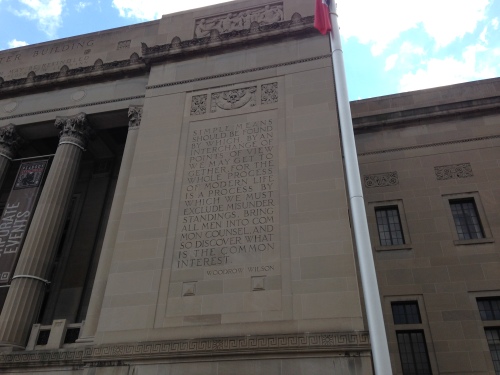
Repentance is not a familiar word anymore. Maybe you have never heard of it. But it is crucial to understanding the gospel. In our day we think that the accumulation of knowledge leads to better outcomes. Across the way outside these doors is an inscription on the side of the public library. It reads, “I choose free libraries as the best agencies for improving the masses of the people because they only help those who help themselves. They never pauperize. A taste for reading drives out lower tastes.” These immortal words of Andrew Carnegie assume that with a library on every corner and knowledge available to all, no one need be poor. The poor will know where to find work, that work will be given to them, they’ll know where to find housing, they’ll remain employed and housed and we’ll all live happily ever after.
Carnegie also said of wealth, “Yet the day is not far distant when the man who dies, leaving behind him millions of available wealth, which was free for him to administer during life, will pass away “unwept, un-honored, and unsung,” no matter to what use he leaves the dross which he cannot take with him. Of such as these, the public verdict will then be: the man who dies thus rich, dies disgraced. Such in my opinion is the true gospel concerning wealth, obedience to which is destined someday to solve the problems of the rich and the poor, to hasten the coming brotherhood of man, and at last to make our earth a heaven.”
I dare say, in his view of knowledge and wealth, Andrew Carnegie had no room for repentance. He thought that we can make heaven here on earth if we just wisely use our wealth. Yet history has shown that instead of closing the gap between the rich and poor, philanthropists have created a nonprofit industrial complex in the billions of dollars that keeps hold of money for the “greater good” in search of those persons who truly deserve it, who won’t be “pauperized” by receiving it. Jesus proclaimed the Gospel by saying “Repent!” Repentance means to turn from the direction we’re heading in because it’s wrong! We might believe it is right, it might be the way the whole world is heading, it might be the way we were taught by our parents, by our schools, by the books we read and the television we watch, but it’s still wrong! Wealth cannot save us! Jesus said, “You cannot serve two masters, God and Mammon.” And Carnegie’s gospel of wealth has become the prevailing gospel in this land.
The Greek word for repentance is metanoia, which indicates a complete turning. Jesus came to change our hearts entirely, to make us new persons, people capable of right love for God and one another. Now the only way repentance is possible is to give up whatever else we are serving. Jesus said we can’t be a slave to sin and free to serve at the same time. Service God’s way means that it’s not on our own terms. Without repentance, any service we render will be with selfish motives. Without repentance we can’t agree with God about how success or outcomes should be viewed. The popular narrative about Christianity these days is that Jesus came to make us nicer people who are more clean-cut, better citizens, living healthy lives, don’t divorce, raise well-mannered kids, and all vote Republican. That idea is severe limitation on what the Dominion of God looks like. We’re not here simply to make others conform to certain limits, but rather we’re all meant to be transformed into God’s likeness in Christ.
Repentance doesn’t mean “become nice” or “become clean”. It means give up! Surrender! Turn! You know you’re not what God wants you to be. You know this ain’t heaven here on earth. You need a Savior! Right where you think you don’t need a Savior, that’s where you need Him the most! And just as the Kingdom or Domain of God is here and yet coming, so we learn that repentance is a beginning that becomes a walk of discipleship, or constantly shedding our old beliefs and habits and turning to want to do the will of God. In my own life as a young man I thought of sin and temptation mainly in terms of sexual misconduct and impure thoughts. That left a lot of room for other types of sins that I thought weren’t as big a deal. As I’ve grown older in learning to be like Jesus, I find I have to continually turn away from hostility, impatience, and a host of other sins that get in the way. I turned from sin, and I’m still on that road to this day.
3. Jesus proclaimed, “Believe the Good News.”
What was the Good News that Jesus proclaimed? What made it news-worthy and what made it good?
The good news is that this world, as we see it and experience it with our natural senses, is not all that there is! There is a different way to be and there is a different future to expect. When we repent and turn to Christ we can actually see God’s hand at work in the world today. The Good News that Christ proclaimed was not simply that he would die for our personal sins so that we could reform and become better people. His proclamation was not that we needed to simply accept him as our personal Lord and Savior. The Gospel was not then and is not now a four point plan of personal deliverance, amendment, and affirmation.
The reason Jesus’ news was good was because this passage was fulfilled: “The Spirit of the Lord is on me, because he has anointed me to proclaim good news to the poor. He has sent me to proclaim freedom for the prisoners and recovery of sight for the blind, to set the oppressed free, to proclaim the year of the Lord’s favor.” (Isa. 61:1-2, Luke 4:18-19) This was not just a message of personal change, but of freedom, healing, and God’s favor! The people eagerly wanted this message. But what became evident as Jesus preached in their synagogues, was that this message was also going to be controversial. When he preached in his own hometown of Nazareth, Luke tells us the people tried to throw him off a cliff.
“28 All the people in the synagogue were furious when they heard this. 29 They got up, drove him out of the town, and took him to the brow of the hill on which the town was built, in order to throw him off the cliff. 30 But he walked right through the crowd and went on his way.” (Luke 4:28-30, NIV)
Why did they get so upset? Because he brought them a word of judgment and of the need for repentance. So they rejected him, and he walked away. He wasn’t the Messiah they wanted after all. And yet he did not give up, he knew his ministry was just getting started.
What does it mean that we should believe the Good News? Quite simply, when the proclamation is made, the hearer must choose whether to accept the word or reject it. In accepting it, belief involves being “all in”, and staking one’s life on this assurance of God establishing His Dominion at this time. In John 8:30 it says that as Jesus was speaking many believed in him. But then a dialog ensues where Jesus lets them know what believing really required. “To the Jews who had believed him, Jesus said, “If you hold to my teaching, you are really my disciples. Then you will know the truth, and the truth will set you free.” When Jesus said we must “believe” it meant more than mental assent. To believe means to cling to, trust in, and rely on the truth that Jesus has accomplished and will accomplish all that God desires.
4. Jesus proclaimed the Kingdom of God, here now and also yet to come in fullness.
I think there are misconceptions about God’s Kingdom. It has been thought to refer only to heaven, or to the Church, or to social justice, and some talk about it as a spirituality that is an inner awareness of one’s own divinity. But when we really read what Jesus said about it, it’s not a kingdom with a castle and moat or with guards to protect it, but it’s referring to how God’s royal authority and power have come on the scene.
It’s important to recognize that Jesus taught that the Kingdom is not created by our own efforts, but is something we receive, when we change and become like children. (Mark 10:14-15) Healings, such as sight given to the blind, feeding 5000 people, dead people being raised, were a witness to the reign of God on earth (Matt. 11:4-5) But the healings themselves were pointing to the power of God, not to a Messiah who would reign from his earthly kingdom.
What Jesus preached and lived did not fit in keeping with the prevailing speculations of the coming Messiah. With the Maccabean revolts just before the time of Jesus, it was thought that the Messiah would give his life for the nation and fulfill the role of the suffering servant, but that he would then rid the land of Greek and Roman influence so that the people would have peace. So when Jesus came preaching a Dominion of God that involved, humility, love, servanthood, and ultimately Jesus death for the sins of the whole world, even his disciples were confused.
Conclusion: The most important message I can declare to you is the good news of Jesus Christ. He taught us that if we want to be somebody in God’s Dominion, we’ve got to humble ourselves and get low. He taught that we are truly blessed when we are poor in spirit. That the things we really want to be are the things this age thinks have no value. Mourning, meekness, a hunger and thirst for righteousness, mercy, Purity of Heart, Peace-making, and persecution for righteousness sake are the distinctives of those who are blessed in God’s Dominion. (Matthew 5:3-11) Personally, I find that the Word of God and my faith in Jesus Christ has ruined me to the other gospels of this world, the gospels of wealth, health, housing, employment, achievement, education, and notoriety. If Jesus lived humility and obedience to God’s will than why should I seek out anything else?
Let’s pray the Lord’s Prayer together, now.
Our Father, who art in heaven,
hallowed be thy Name,
thy kingdom come,
thy will be done,
on earth as it is in heaven.
Give us this day our daily bread.
And forgive us our trespasses,
as we forgive those
who trespass against us.
And lead us not into temptation,
but deliver us from evil.
For thine is the kingdom,
and the power, and the glory,
for ever and ever. Amen.
Filed under Personal





 ADKF
ADKF 